





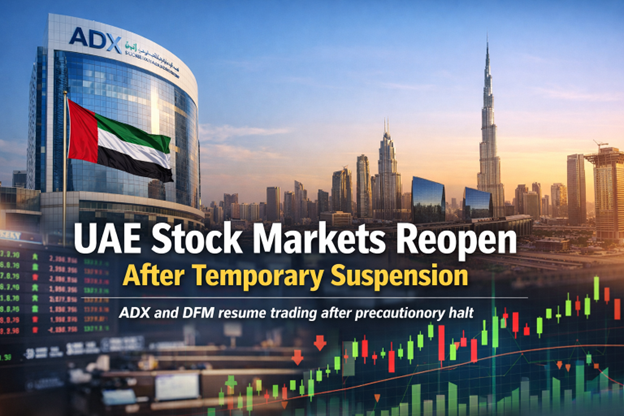
The United Arab Emirates’ financial markets are preparing to resume full operations after a temporary shutdown triggered by rising geopolitical tensions in the Gulf. Trading activity on the Abu Dhabi Securities Exchange (ADX) and the Dubai Financial Market ( DFM) was suspended for two days as a precautionary measure to ensure market stability and investor safety.
Authorities confirmed that both exchanges will reopen under closely monitored conditions. The suspension was not caused by technical failures or financial instability but was instead a proactive decision taken during a period of heightened regional uncertainty. This temporary halt allowed regulators and market participants time to assess risks and ensure trading systems were fully secure before reopening.
According to Reuters, UAE Markets Reopening, the decision to reopen came after regulators reviewed market risks and confirmed that systems were stable. The suspension was described as precautionary and aimed at protecting investors during a period of uncertainty.
Why Trading Was Suspended
The precautionary halt came after rising geopolitical tensions across the Gulf region. Security concerns linked to missile and drone activity created uncertainty across financial markets, prompting authorities in the United Arab Emirates to act swiftly.
Market regulators emphasized that temporary suspensions are sometimes necessary during periods of geopolitical instability. These measures help prevent panic selling and protect investors from sudden price swings. By pausing trading, authorities aimed to maintain orderly market conditions and reduce the risk of excessive volatility.
Reuters reported about Stock Market Suspension that the tensions followed retaliatory strikes in the region that disrupted airspace and affected business sentiment. While the UAE’s economic fundamentals remained strong, investor caution increased during the escalation.
Safe and Stable Market Reopening
Before approving the reopening, regulators conducted a full review of trading infrastructure and risk management systems. Authorities worked closely with exchange operators to ensure a smooth transition back to normal operations.
Both exchanges continue to publish updates on their official platforms:
Abu Dhabi Securities Exchange (ADX) and the Dubai Financial Market ( DFM)
These platforms provide investors with real-time updates, trading notices, and operational announcements.
Officials also confirmed that safeguards remain in place to manage volatility if market fluctuations increase after reopening. Circuit breakers and trading controls are available to maintain orderly conditions if needed.
Regional Market Impact
Financial markets across the Middle East experienced fluctuations during the suspension period. Investors monitored developments closely as geopolitical tensions influenced oil prices, transportation routes, and regional trade activity.
Some Gulf markets recorded declines as uncertainty weighed on investor sentiment. However, analysts suggest that the reopening of UAE exchanges is a positive signal for regional stability and investor confidence.
Reuters also noted broader Regional Market Impact movements during the same period. Gulf Cooperation Council sovereign wealth funds can play a pivotal role in supporting local equity markets by boosting liquidity and deploying additional capital to strengthen investor sentiment
What This Means for Investors
As trading resumes on the Abu Dhabi Securities Exchange (ADX) and the Dubai Financial Market ( DFM), investors may notice increased activity during the first few sessions. Market participants often adjust their portfolios after a trading halt, which can lead to temporary price movements and higher trading volumes. Some sectors, especially banking, energy, and real estate, may see quicker reactions as investors respond to regional developments.
However, the regulated reopening and close monitoring reduce the likelihood of extreme fluctuations. Authorities have systems in place, such as trading limits and circuit breakers to maintain orderly market conditions. These measures help prevent panic selling and sudden price swings.
In the short term, investors may remain cautious while monitoring geopolitical developments. In the long term, analysts expect the markets to stabilize as confidence returns and normal trading patterns resume. The reopening itself signals strength in the UAE’s financial system and reinforces investor trust.
Key Takeaways
The Abu Dhabi Securities Exchange and Dubai Financial Market are reopening after a two-day suspension that was implemented as a precautionary step to maintain financial stability. The temporary halt was introduced to protect investors and reduce the risk of sudden market volatility during a period of regional tension. Regulators reviewed market conditions carefully before approving the reopening, ensuring that trading systems were secure and ready. Markets are now resuming operations under monitored conditions, although some short-term fluctuations may still occur as investors respond to recent developments.
Key Points:
- ADX and DFM reopening after a two-day suspension
- Temporary halt introduced as a safety measure
- Decision made to protect investors
- Regulators ensured market readiness
- Trading resumes under supervision
- Some volatility may continue in the short term
